Quarters, Nostalgia, and TikTok: Why Gen Z Is Obsessed With Old-School Arcades

Photo: Stougard, CC BY-SA 3.0, via Wikimedia Commons
Walk into any buzzing arcade bar in Austin, Chicago, or Brooklyn on a Friday night and you'll notice something that would've seemed impossible a decade ago. The crowd isn't full of middle-aged guys reliving their childhoods. It's packed with 22-year-olds in vintage tees, phones pointed at flickering CRT screens, laughing over games they've technically never played before.
Something shifted. Retro gaming didn't just survive — it came roaring back, and a generation raised entirely on digital experiences is leading the charge.
The Nostalgia Paradox
Here's the weird part: Gen Z has no actual nostalgia for the golden age of arcades. The heyday of Pac-Man and Donkey Kong was the early '80s. Most Gen Z kids were born in the late '90s and 2000s. So why are they so drawn to machines that predate them by decades?
Psychologists call it "vicarious nostalgia" — a longing for an era you never actually lived through but feel culturally connected to through media, family stories, and aesthetic cues. Gen Z grew up watching their parents talk about arcades with a particular kind of warmth. They absorbed it through retro-styled games, pixel art trends, and shows like Stranger Things, which practically made the local arcade a romantic symbol of American childhood.
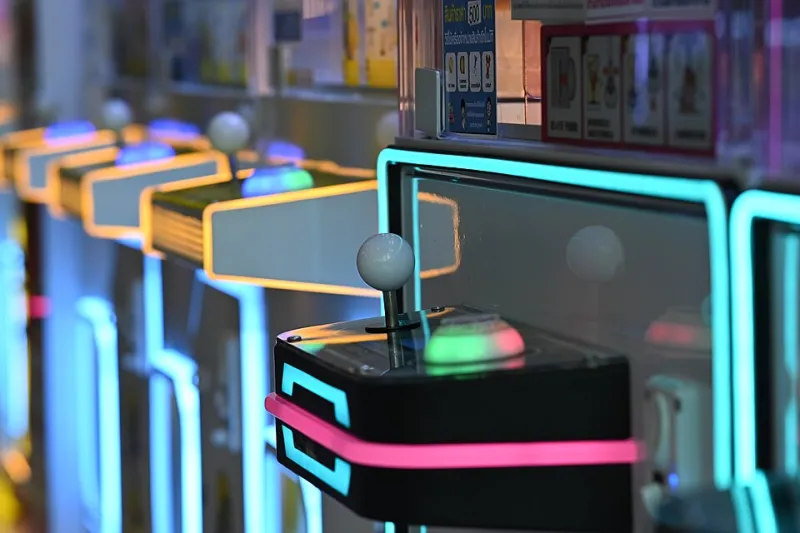
The machines themselves carry a visual and tactile language that feels simultaneously ancient and cool. There's something genuinely striking about a six-foot cabinet glowing in a dark room, joystick worn smooth by thousands of hands before yours.
Social Media Turned Old Cabinets Into Content Gold
If vicarious nostalgia lit the fuse, social media was the explosion.
Arcade content absolutely thrives on TikTok and Instagram. The reasons are almost algorithmic in how well they align. Bright flashing lights, satisfying sound effects, physical skill on display, the unpredictability of a claw machine or a pinball table — these translate into deeply watchable short-form video. A clip of someone pulling off a ridiculous combo in Street Fighter II or finally beating Galaga on one credit hits differently than a screen recording of someone playing a mobile game.
Influencers and content creators figured this out fast. Arcade bars became backdrop gold. "Retro gaming" became a reliable content niche with massive engagement. And as those videos racked up views, curiosity followed. People who'd never touched a joystick started seeking out the experience for themselves.
Here at 125520 Arcade, we've seen this play out in our own community — the questions we get from younger readers about where to find working cabinets, which games are worth learning, and how to actually get good at something without infinite lives have multiplied dramatically over the past few years.
The Arcade Bar Boom Is Very Real
The business side of this trend is just as fascinating as the cultural side. Arcade bars — venues that combine craft beer, cocktails, and free-play arcade machines — have exploded across major US cities. Spots like Emporium Arcade Bar in Chicago, Barcade (with locations in New York, Philadelphia, and beyond), and Ground Kontrol in Portland have gone from novelty concepts to legitimate entertainment staples.
The model works because it solves a real problem for young adults. Traditional bars can feel passive. Movie theaters are quiet and solo. But an arcade bar offers something increasingly rare: a reason to actually interact with the people you came with. You're competing, cheering, trash-talking, and sharing something physical and immediate.
For venue owners, the economics are compelling too. Vintage cabinets — once considered clunky relics — have become serious collector's items. A fully restored Ms. Pac-Man cabinet can command thousands of dollars. Owning a floor full of them isn't just atmosphere; it's a genuine asset.
The Tactile Hunger Underneath It All
There's a deeper pull here worth examining. Gen Z grew up in a world of frictionless digital experience. Everything is a tap away. Games are downloaded instantly. Rewards come fast and often. The physical world — with its resistance, unpredictability, and consequence — can feel almost foreign.
Arcade games push back. A joystick has real resistance. Buttons have real click. A bad move costs you a quarter and there's no respawn. That friction, which once frustrated players, now feels almost refreshing. It's a form of digital detox wrapped in neon lighting.
Researchers studying the psychology of play have noted that younger generations are increasingly seeking experiences that feel "earned" — where skill visibly translates into outcome. Arcade games, with their steep learning curves and unforgiving scoring systems, deliver exactly that. There's a reason people still crowd around a machine when someone's deep into a record-breaking run. It's live, it's real, and it could end at any second.
What This Means for the Future of Arcades
The retro gaming revival isn't a blip. It's become a genuine cultural institution, and the businesses and communities building around it are getting more sophisticated every year. Independent operators are curating collections with real intention, mixing golden-age classics with '90s fighting games and even modern indie titles that embrace the arcade format.
And the aesthetic has bled far beyond the venues themselves. Pixel art is mainstream graphic design. Chiptune music scores indie films. Retro gaming references are currency in everything from fashion to advertising.
Gen Z didn't discover arcades by accident. They found them at the intersection of authenticity-seeking, social experience hunger, and an algorithm that rewards visually striking content. And once they found them, a lot of them didn't want to leave.
That quarter-eating cabinet in the corner? It's not a relic anymore. It's the centerpiece of the party.