The Coin Slot Vanishes: How Tokens, Cards, and Wristbands Are Redividing the Arcade
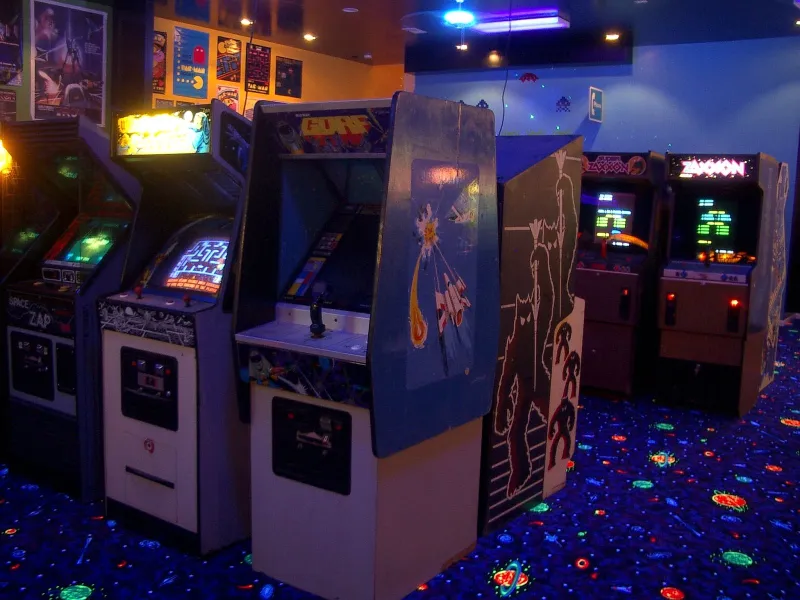
Photo: arcade payment kiosk with tokens cards and wristbands, modern arcade interior, via i.pinimg.com
The coin slot is one of the most consequential pieces of industrial design in American leisure. It is a tiny mechanical gate that turned a pastime into a business model: drop a coin, get a credit, play until you lose. For roughly fifty years, that gate defined the arcade. In 2026, it is disappearing.
Walk into a modern arcade and you will find three competing payment systems sharing the floor: tokens, stored-value cards, and all-you-can-play wristbands. Each one solves a different problem. Each one also changes player behavior in ways that are only now becoming clear. This is the quiet war over how you pay to play — and it is reshaping the economics of the arcade from the inside out.
The Economics of a Quarter
The quarter was a marvel of alignment. It was small enough to feel disposable, large enough to feel real. It gave the player a natural unit of play — one credit — and gave the operator a clean cash flow with no processing fees. It also created a hard ceiling: a player could only spend as many quarters as they had in their pocket.
That ceiling was the point. Arcade designers built difficulty curves around the quarter. A game that ate a dollar in ninety seconds was a bad game. A game that gave you three minutes for a quarter was a good one. The coin slot was a feedback loop between the designer and the player's wallet, and it kept both honest.
It also created a physical ritual. You walked to the change machine. You fed bills into a slot. You got a cup of tokens or a handful of quarters. You counted them. The counting was part of the experience — a small ceremony that separated the outside world from the inside one.
Tokens: The Original Closed Loop
Tokens arrived early, mostly as a way to keep machines from being robbed and to keep players from spending their laundry money elsewhere. A token is a closed-loop currency: it only works here. That is its strength and its limitation.
Operators love tokens because they control the exchange rate. Sell ten tokens for a dollar, price every game at two tokens, and you have effectively raised the price without changing the number on the cabinet. Players love tokens because they feel like treasure. They jingle. They stack. They can be traded, hoarded, and given away. A kid with a cup of tokens feels rich in a way that a kid with a card balance does not.
The downside is friction. Tokens require a staffed counter. They require inventory, security, and reconciliation. They get lost, stolen, and counterfeited. And they are a nightmare for the modern operator who wants to know, in real time, which machines are earning and which are not.
Stored-Value Cards and the Data Dividend
The stored-value card solved the data problem. A card is a unique identifier. Every tap is a transaction, and every transaction is a data point. Operators can now see which cabinets are hot, which are cold, and which players are spending the most. They can run promotions, offer bonuses, and track loyalty in ways that were impossible with cash.
The card also solved a staffing problem. A self-service kiosk can sell and reload cards with no counter attendant. That matters in a market where labor is expensive and turnover is high.
But the card introduced a new psychological effect: the balance blur. When you pay with a card, you stop counting. A dollar feels like a number on a screen, not a coin in your hand. Players consistently spend more with cards than with cash — not because they are reckless, but because the pain of payment is delayed. The card is frictionless, and frictionless spending is the whole point of the card business.
That is good for operators and complicated for players. A parent who hands a kid a twenty-dollar card has no idea how fast it will disappear. A kid who taps a card has no idea how fast they are tapping. The coin slot used to answer that question for them.
Wristbands and the All-You-Can-Play Math
The wristband is the newest and most disruptive model. You pay a flat fee — often twenty or thirty dollars — and you play unlimited for a set window, usually two or three hours. It is the arcade equivalent of a buffet.
The math is attractive for families. A parent with three kids can budget a single number and stop worrying about the meter. The wristband also encourages players to try machines they would never have paid for individually. That is good for discovery and good for the operator's least popular cabinets.
But the wristband changes the design incentive. If a player has already paid, the operator no longer cares how long a game lasts. In fact, the operator may prefer shorter games, because shorter games mean more players cycling through the floor. That is the opposite of the quarter-era incentive, where a game had to be fair enough to keep you feeding it.
There is also the queue problem. All-you-can-play models encourage camping. A player who has paid a flat fee has no reason to leave a machine they are enjoying. Operators counter this with time limits, social pressure, and the occasional staff nudge, but the friction is baked in.
What Players Gain, What They Lose
Each system trades something. Tokens give players a tangible sense of value and a ritual of exchange. Cards give convenience and data. Wristbands give predictability and freedom.
What is lost across all three is the quarter's built-in stop signal. The quarter told you when to stop. It ran out. The card does not run out until you check the balance. The wristband does not run out at all until the timer does. That is a meaningful shift in how players experience a budget, and it is not clear yet whether the trade is worth it.
The Operator's Reckoning
The operators I spoke with are not sentimental about the coin slot. They are practical. Cash handling is expensive. Coin jams are a maintenance nightmare. The coin mech is the most failure-prone part of any cabinet. A cashless system pays for itself in a year.
But several of them also admitted to a quiet worry: that the arcade is losing the thing that made it feel different from a movie theater or a bowling alley. The quarter was a shared language. It was a small, countable stake. It made the room feel like a game, not a transaction.
The Future of the Friction
The likely outcome is not a victory for one system but a hybrid. Tokens will survive in retro and barcade settings, where the ritual is part of the appeal. Cards will dominate larger family entertainment centers. Wristbands will own the birthday-party and tourist corridors.
The interesting question is whether any of them can recreate the quarter's most underrated feature: the natural stopping point. A good payment system does not just take money. It tells the player when to stop, and gives them a reason to come back. The quarter did that with a piece of metal. The card does it with a screen. The wristband does not do it at all.
That is the trade the arcade is making in 2026. It is getting faster, cleaner, and more data-rich. It is also getting a little less countable. Whether that is a fair exchange depends on what you think an arcade is for. If it is a place to spend money, the new systems win. If it is a place to spend time, the old one still has a case.