Painted Promises: The Artists Who Sold You the Game Before You Ever Touched a Joystick
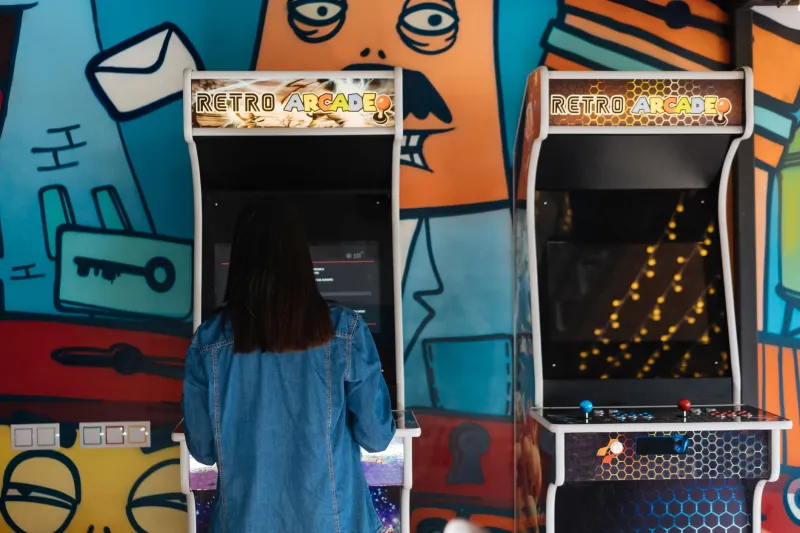
Walk into any decent barcade in Austin or Portland and your eyes will find them before your brain registers the game itself: a snarling samurai, a chrome-plated robot mid-explosion, a rubber-scaled lizard stomping toward a tiny pixelated city. Nobody painted those monsters for art's sake. They painted them because a kid in a mall in 1983 had roughly four seconds of attention to give, and that kid had to be convinced — visually, violently, instantly — that this machine was the one worth their quarter.
That's not game design. That's salesmanship at 60 miles an hour, done in gouache and airbrush by people whose names almost nobody remembers.
The Four-Second Pitch
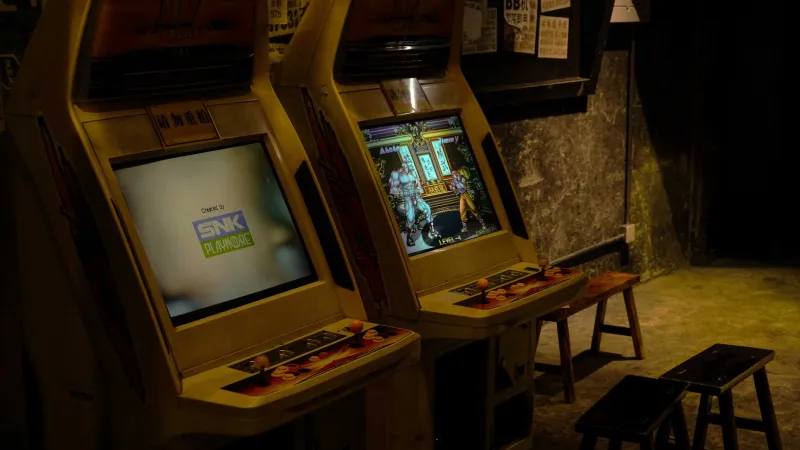
Think about what an arcade actually looked like during the golden age. Rows of cabinets, back to back, all screaming for attention under fluorescent light. The screen was small, the sound bled together, and the gameplay — well, you couldn't see the gameplay until you were already standing there. What you could see was the cabinet. The marquee glowing overhead. The side panels facing the aisle like billboards.
So the artwork carried the entire burden of the pitch. A cabinet for a space shooter needed to look like a movie poster for a space war. A fighting game needed fists, fire, and faces full of rage. The illustrators delivering that were working commercial artists, many trained in advertising or paperback cover illustration, cranking out pieces on brutal deadlines for game manufacturers who often barely explained what the game even did.
Some of those artists never played the games they illustrated. Some only saw a design document or a few sprite sheets. They were painting a feeling — aggression, heroism, cosmic menace — based on a paragraph and a deadline. And somehow, they nailed it often enough that forty years later, collectors can identify a cabinet from across a convention hall by nothing more than the curve of a painted flame.
Why the Art Still Works on Your Brain
Here's the part that fits squarely into the psychology of it all: cabinet art was doing something screens can't. It was a physical promise, rendered at human scale, right next to your body. The game on screen was abstract — blocky, limited, suggestive. The art on the cabinet was the fantasy version of what you were about to do. Your brain filled the gap between the two, and that gap is where the excitement lived.
That's a classic expectation engine, and it's the same mechanism modern game marketing uses in trailers and key art. The '80s cabinet artists were just doing it with paint, on wood, at eye level, for kids.
It also explains why restored cabinets with faded or repainted art feel subtly wrong to hardcore collectors. The artwork isn't decoration — it's half the experience. A machine with original, vibrant side art doesn't just look better; it plays better in your head.
The Collectors Who Grade Paint Like Fine Wine
Spend any time in the American arcade collecting scene and you'll learn that condition ratings hinge heavily on artwork. Scratches on a control panel? Repairable. A sun-bleached marquee? That's a value hit. Original, unfaded side art on a desirable title can swing a machine's price by thousands of dollars.
Why? Supply, mostly. The ink and vinyl used in the '80s aged badly, especially under the UV assault of mall skylights and corner-store windows. Most cabinets lived hard lives in public spaces before being discarded. Surviving original artwork is genuinely rare, and rarity plus nostalgia equals a market.
Collectors have developed an almost appraiser's vocabulary for it — checking for factory seams in the side art, matching ink colors against reference photos, debating whether a reproduction panel is a respectful restoration or a forgery-adjacent sin. Sound familiar? It's the exact culture war that plays out in every collecting hobby, from baseball cards to vintage guitars.
The Revivalists With Inkjet Printers and Archival Patience
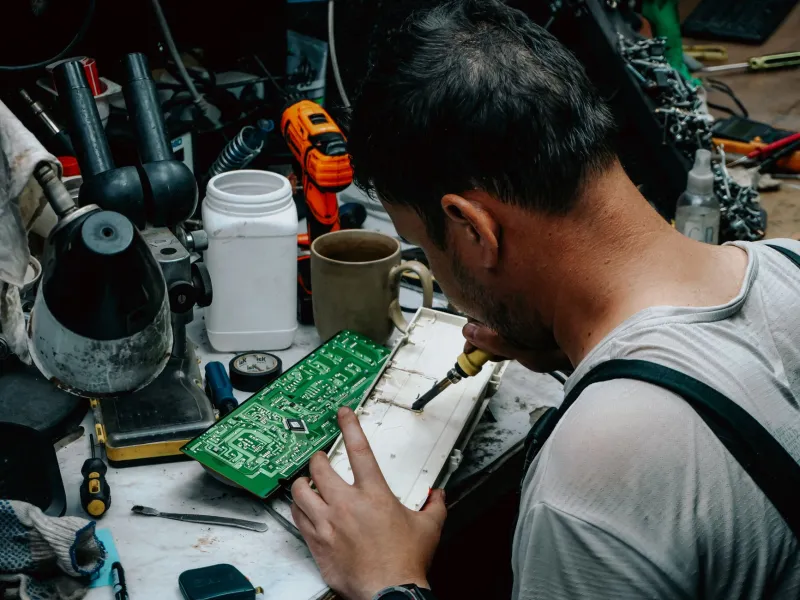
The good news for anyone restoring a cabinet today: the artwork is coming back. A small network of enthusiasts has spent years tracking down original art files, photographing surviving cabinets at high resolution, and rebuilding damaged pieces pixel by pixel in Photoshop. Some have gone further, tracking down retired illustrators and getting their originals scanned properly for the first time.
Reproduction side art has gotten genuinely good — printed on archival vinyl with color matching that would've been impossible a decade ago. For purists, it's a compromise. For everyone else, it's the difference between a dead cabinet in a garage and a machine that lights up a game room again.
And there's a newer wave, too: contemporary artists designing original cabinet art for modern indie arcade machines, deliberately channeling the airbrush-and-explosion language of the '80s. The style has outlived the industry that created it.
Names Worth Knowing
The frustrating part of this story is how many of these artists remain uncredited — work-for-hire contracts, defunct companies, no paper trail. But in the collecting community, the detective work continues, and a handful of names have been rescued from obscurity. Every time one gets properly documented, it's a small act of justice for a field that treated its artists as anonymous hands.
So the next time you're standing in front of a cabinet — original or reproduction — take ten seconds before you feed it a token. Look at the marquee. Look at the side panels. Somebody painted that, probably fast, probably for a flat fee, and definitely without knowing their work would still be pulling people in half a century later.
The game got your quarter. But the painting got you to the machine in the first place.